
I have recently found myself in uncharted reading territory: classics from the 18th and 19th centuries. In an effort to increase my cultured reading and literary analysis skills, I’ve opted to take two additional undergraduate English courses, “Sexuality and Literature” and “Modern Novel”. Both of these require comprehensive reading of old literature, starting with the likes of Jonathan Swift, Jane Austen, and John Wilmot.
While I am enjoying reading these for the sake of literary analyses, they’re not books I can sit down and binge-read like those of Leigh Bardugo and Brandon Sanderson. Not only is there the adjustment to the inconsistent English writing style, but I frequently have to check the Explanatory Notes (which I am incredibly grateful for) at the back of the Oxford publications of these works. This is especially true for Swift’s novel Gulliver’s Travels.
Gulliver’s Travels is a name that most are probably familiar with. Written in the early 1700s, it’s been a popular work of fiction for quite some time. This is evident through its continued use in college courses, references in popular culture, and modern movie productions (with the blessed Jack Black as Gulliver). The story is fun, bizarre, and maintains a staggering amount of both veiled and obvious political commentary.

I understand the importance of separating author from narrator, but Swift makes that lack of separation a main point in his story. Gulliver is a character who craves adventure but typically is portrayed as passive, letting events happen to him and around him and later narrating his experiences to the readers. Each place he travels turns into some political commentary or another, and each drips with satire. Large portions of the subject matter relate to life under King Charles I and other leadership at that time, and Swift’s primarily Tory and Jacobite political views.
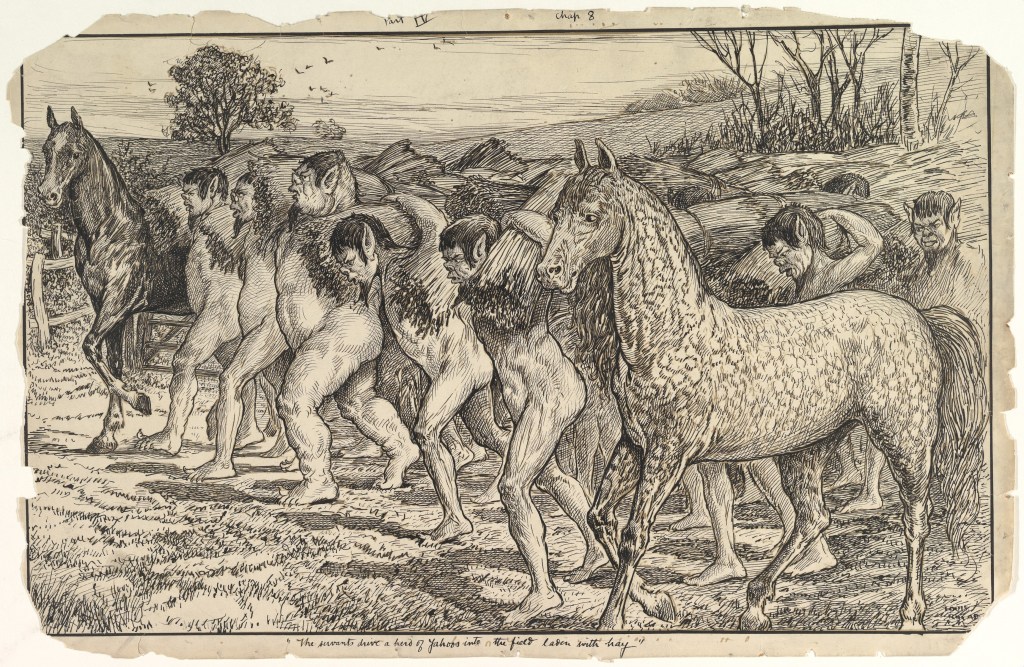
He tended to use royal members of the countries he visited to point out all of the terrible things his own country did, while portraying Gulliver as an understanding but loyal bystander. For instance, Lilliput was strong but fought over trivial matters and enunciated the scandals and ridiculousness of court, while Brobdingnag pointed out all the barbaric qualities of England, and ultimately viewed them as silly. Laputa was so focused on only specific and relatively useless scientific innovation that their heads were in the clouds, keeping them from succeeding in any endeavor whatsoever. The Houyhnhnms were the only respectable society, living in such perfection that there was no understanding of war, lies, deceit, selfishness, or wishing harm on a neighbor. The catch? The Houyhnhnms were horses. In this imagery, Swift makes it clear that humans fall short of the rational animals many believers claim them to be. However, he also does not bestow this rationality on other animals, instead satirizing their sentience and intelligence as belonging to a beast of burden (which I believe is supposed to indicate an impossibility).
Swift also makes Gulliver’s character as what can only be described as an avid hater of women. Throughout his story women are ridiculed, belittled, and existed as beings whose behavior and intellect were the only things that remained constant throughout his travels: “But he may please to consider, that the Caprices of Womankind are not limited by any Climate or Nation; and that they are much more uniform than can be easily imagined” (p 152 Oxford version). His women are typically judged by appearance, interested only in gossip, and are not capable of understanding any topic worthy of conversation. In the few positive mentions of “womankind”, the recipients are either young girls or become the instigating cause of his national banishment.
Gulliver’s Travels was an interesting read that gave insight into some of the political commentary of historical events and nature of the early novel. I enjoyed the story, although it would have taken much longer to read if it had it not been for a class. Regardless, I do not want to rate books that are classics. We will read a few more modern novels for these classes as well, but I may not rate those either. It seems more fair and honest that since my opinions will largely be influenced by class discussions and in-depth dissections, I can instead post large-scale thoughts and summaries without the presence of a rating. Let me know if you’ve read Gulliver’s Travels, and what your thoughts were. Definitely also share your thoughts if you’ve seen the 2004 film with Jack Black (a national treasure). Enjoy!








 A Penny For Your Books
Leave a comment